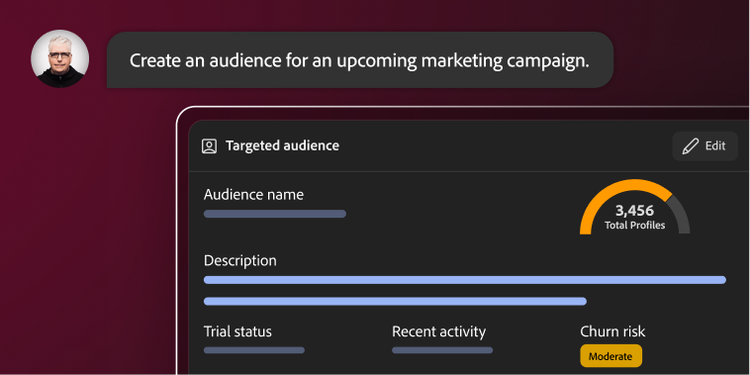
Coworker Chat
A conversational interface for automating individual CXO tasks through natural language, planning, and execution.
Primary use caseRapid task ideation and execution, including insights extraction and object creation.
Orchestrate customer experiences with automated workflows.
An AI-powered teammate for customer experience and marketing work. It turns high-level goals and insights into coordinated execution across Adobe and connected systems — with enterprise context, approvals, and human oversight built in.
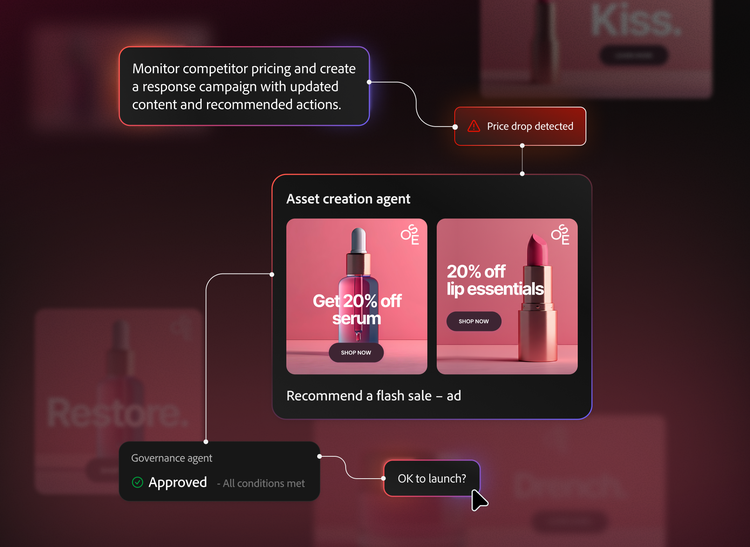
A short field-readiness walkthrough of how Adobe CX Enterprise Coworker moves teams from goal to governed execution. Hosted on Highspot — sign in with your Adobe credentials to view.
From high-level goal to coordinated, governed execution across CX workflows.
Adobe CX Enterprise Coworker combines data, intelligence, collaboration, agentic skills, enterprise context, governance, and human oversight to turn goals into coordinated action across Customer Experience Orchestration applications and third-party systems.
Customer one-liner: Coworker helps teams move from goals and insights to coordinated execution across customer experience workflows — with enterprise context, approvals, and human oversight built in.
Enterprise work spans teams, systems, approvals, assets, audiences, and reporting. When those live in disconnected tools, execution slows and people spend their time coordinating rather than delivering.
Coworker provides an orchestration and intelligence layer that works alongside existing applications — it does not replace your systems of record.
Naming discipline: Use “Adobe CX Enterprise Coworker” on first mention and “Coworker” after. Do not use “CoWorker,” “Co-Worker,” or “Cowork,” and per the current FAQ, do not describe Coworker as a “platform.”
The core promise of Coworker in three ideas — each mapped to what it means and why it is relevant to the customer.
Automates tasks and workflows across Adobe and third-party systems, with approvals, collaboration, and oversight throughout.
Business relevance: Fewer handoffs, faster execution, and more consistent operating processes.
Uses enterprise context, domain intelligence, and long-term memory to support precise, faster execution from the start.
Business relevance: Less time re-establishing context, and better alignment to the customer's environment.
Supports a purpose-built workspace, or activation of Adobe capabilities from other agentic systems and interfaces.
Business relevance: Fits existing technology strategies and reduces pressure to replace existing tools.
Three ways teams engage Coworker today and next. Every output is grounded in the customer's business context.
A conversational interface for automating individual CXO tasks through natural language, planning, and execution.
Primary use caseRapid task ideation and execution, including insights extraction and object creation.
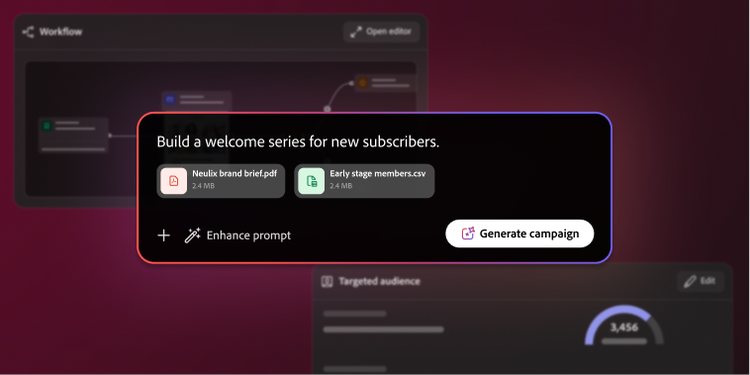
A chat-based, templatized experience for standing up and executing campaigns from a single prompt.
Primary use caseSelf-service, quick campaign building and deployment for small, agile teams. Regional availability is time-sensitive.
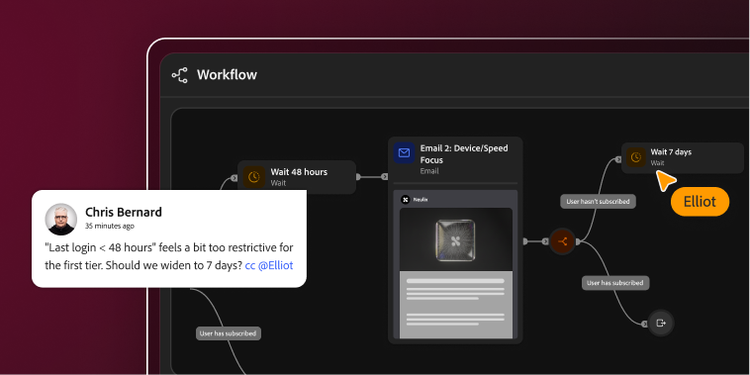
A unified, goal-oriented workspace for end-to-end CXO workflow automation, collaboration, and approvals.
Primary use caseCross-team workflow orchestration from strategy through delivery.
Building blocks behind the modules: CX enterprise harness & AI orchestration · reusable skills · business context (brand, KPIs, taxonomy) · long-term memory · MCP tool calls & product APIs · customer data foundation & governance · collaboration, approvals & workflow building.
Seven recurring workflows where the orchestration-and-intelligence layer reduces coordination cost and shortens the path from signal to governed action.
Fragmented planning, production, approvals, and launch.
Fewer manual handoffs; faster, more precise execution; repeatable processes.
Signals are reviewed periodically and adjustments happen slowly.
Faster response to performance changes and closer alignment to objectives.
Content reviews, brand checks, data policies, and approvals create bottlenecks.
Faster approvals, greater consistency, reduced operational risk — human review preserved.
Time lost finding data, building views, and translating findings into action.
Faster answers, broader analytical participation, shorter time from insight to action.
Understanding audience size, growth, duplication, activation, and product intent.
Faster audience assessment and improved readiness for activation and journey planning.
Visibility into live journeys, test status, scheduling conflicts, fallout, and overlap.
Faster troubleshooting and better-informed journey decisions.
Work split across applications and teams requires manual coordination.
Less tool switching, better collaboration, and improved use of existing technology investments — acting across Adobe and connected systems while maintaining context, approvals, and oversight.
Business-value statements are suggested measurement framing to guide discovery, not reported customer results.
Analytics is a strong entry scenario: the value is not only faster reporting, but reducing friction across the full chain — from question, to analysis, to decision, to approved action, to ongoing optimization.
Natural-language interaction supports direct questioning.
Reduce friction between a business question and an analytical response.
Data analysis, visualization, inline charts, and tables support exploration.
Accelerate common analysis and make findings easier to consume.
Enterprise context, domain intelligence, and memory support relevance.
Improve decision support by grounding work in the customer environment.
Positioned to orchestrate actions across workflows with approvals and oversight.
Shorten time from insight to governed execution.
Persistent memory is positioned to retain preferences and prior-session context.
Improve continuity and reduce repeated setup.
Sample prompts for Data Insights, Audience, and Journey jobs. Natural-language analysis draws on Customer Journey Analytics data.
Respond to the common questions with confidence — and without claiming more than the materials support.
“Adobe CX Enterprise Coworker is an AI-powered teammate for customer experience work. It helps teams move from goals and insights to coordinated execution across Adobe and connected systems. The business value is faster workflows, fewer handoffs, better-informed decisions, and governance through permissions, approvals, collaboration, and human oversight.”
The commercial routes described in the cited materials. Every figure below is time-sensitive — confirm current terms before any customer conversation.
| Pathway | What the source says | Currency caution |
|---|---|---|
| Trial | Up to 10,000 AI Credits for eligible customers; Coworker Chat inputs consumed 25 credits per input for a limited introductory period. | Eligibility and rates are subject to change; validate before use. |
| Launch Offer | $20K list price, six-month duration, unmetered subject to fair use, transactable until December 31, 2026. | Time-sensitive. Validate current availability and terms. |
| AI Credits | Purchase a volume of credits with differentiated charges by action; cited flat price is $0.20 per credit for the specified pathway. | Updated rate-card guidance is forthcoming; validate current guidance. |
| ENT License | Unmetered tiers based on CXO licensed software ARR, with a stated minimum ARR threshold and target-price framework. | Use current Deal Desk and authoritative pricing guidance only. |
Currency & conflict note. The FAQ is a living document, last updated August 24, 2026 (trial section July 21, 2026). Availability, rollout, region access, trial eligibility, credit rates, price, licensing tiers, and roadmap statements are time-sensitive. Some older internal documents use naming that conflicts with current guidance — always revalidate in authoritative current sources before external use.
Tap a question to reveal the answer. Aim to answer each one out loud before you check.
Watch the readiness video, then explore the product overview to sharpen your discovery, positioning, and demo narrative.